
Core technologies
Ammonia systems.
Efficient, robust, performance-driven industrial refrigeration.
Ammonia benchmarks
With expertise built up since 1980 and a brand with more than 25 years of experience, APINA stands as one of the world's leading manufacturers of ammonia refrigeration machinery.
Our apiHiGreen machines are defined by maximum efficiency and reliability that meets the highest demands. From the food sector to processing and the marine industry, they have proven able to cover every kind of need.
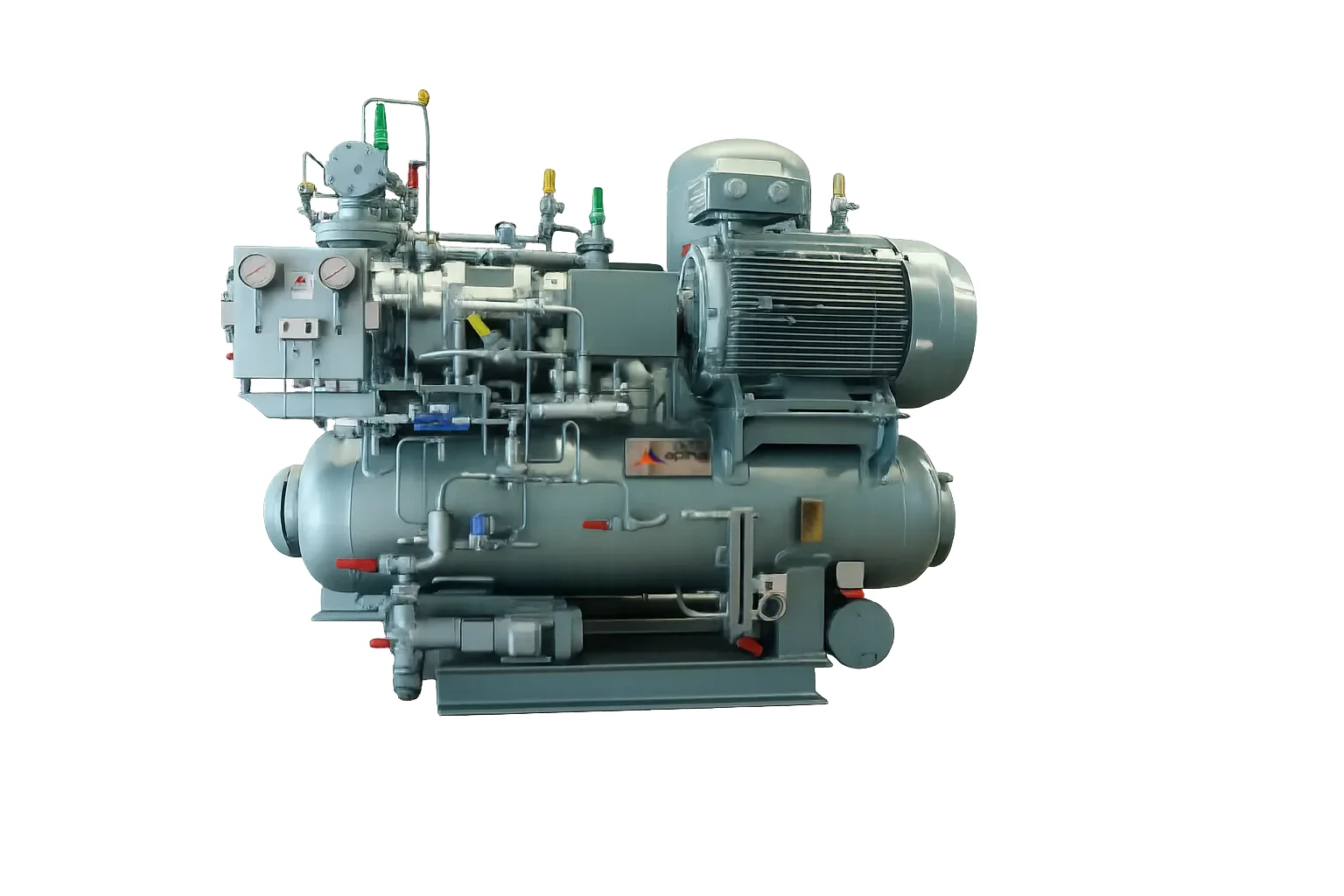

apiHiGreen technology
Maximum efficiency
Unique designs that increase system efficiency and give it the highest possible reliability.
Low ammonia charge
Compliant with the IIAR and IIR/IIF definitions of Low Ammonia Charge, with refrigerant levels optimised to the maximum.
Multi-sector
Solutions proven in food, industrial processing and the marine sector.
Safety and standards
High safety and an optimal response to the restrictions of the European F-Gas regulation.
Why ammonia (NH₃ · R717)
Ammonia is a natural refrigerant —a molecule of nitrogen and hydrogen, not a halocarbon— with zero global warming potential (GWP 0) and zero ozone-layer damage (ODP 0). It falls outside the F-Gas phase-out calendar that is progressively removing fluorinated gases: a future-proof choice.
It is also the most efficient refrigerant for industrial cooling: it absorbs about 7 times more heat per kilogram than a conventional HFC, with a typical COP of 4 to 6. That means smaller refrigerant charges, more compact piping and heat exchangers, and electricity consumption 10 % to 15 % lower than an equivalent system —all at a very low cost per kilo.

Advantages of ammonia
GWP 0 · ODP 0
Natural refrigerant, with no greenhouse effect or ozone-layer damage, outside the F-Gas bans.
Maximum efficiency
Up to ~7× more heat per kilogram and a COP of 4–6: less electricity for the same cooling.
More compact equipment
Its high capacity per kg allows smaller piping, heat exchangers and refrigerant charges.
Down to −70 °C
Covers medium and low temperature, reaching industrial ultra-freezing.
Low, stable cost
An abundant, inexpensive refrigerant, without the volatility or restrictions of fluorinated gases.
Managed safety
Detectable odour at minimal concentrations (early self-alarm) and Low Charge designs that reduce the NH₃ inventory.
More in core technologies