
Core technologies
Absorption refrigeration.
For processes where thermal energy becomes an industrial advantage.
Compression without a compressor
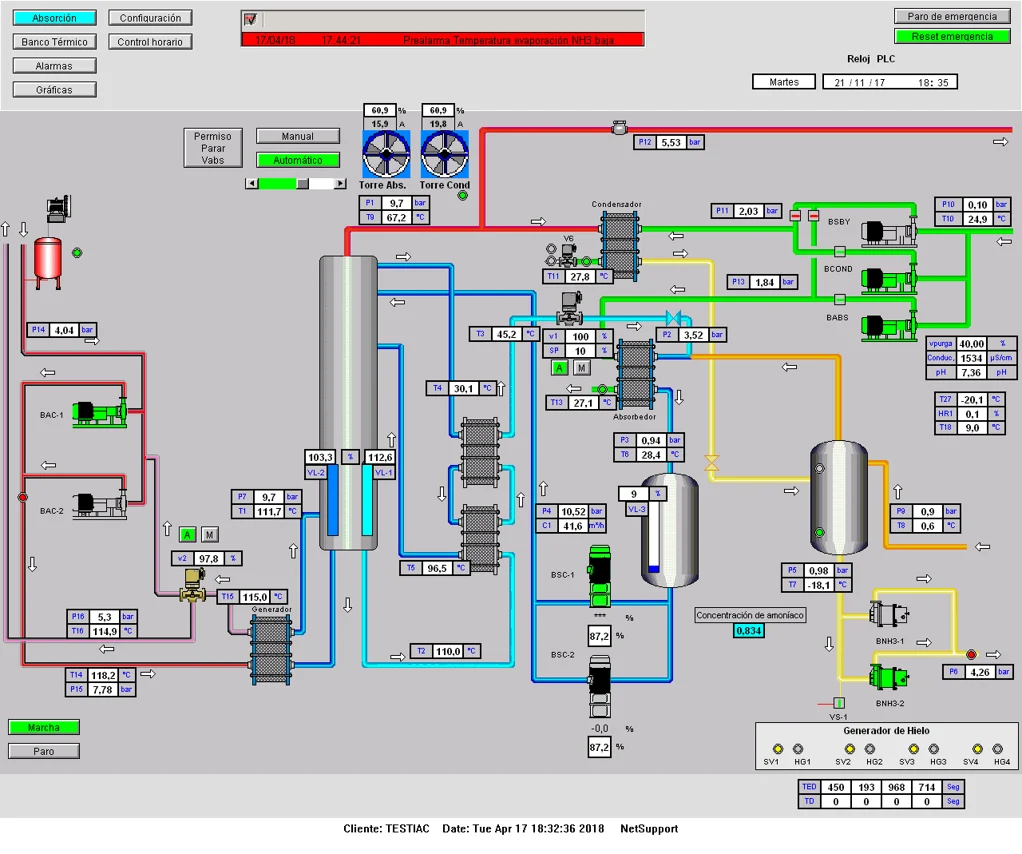
In an absorption refrigeration system, the mechanical compressor is replaced by a physico-chemical compression: an absorption and desorption process. Mixing ammonia and water in different concentrations changes the refrigerant's vapour pressure, achieving evaporation and condensation under the desired conditions.
They are ideal when a continuous heat source is available: they use the waste heat of an industrial process to meet cooling demand. They need barely any electricity —around 5 % of an equivalent compression system— with lower operating cost and the lowest environmental impact.
APINA's compact module
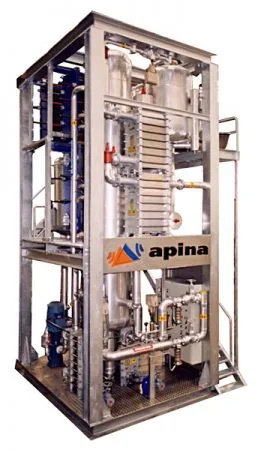
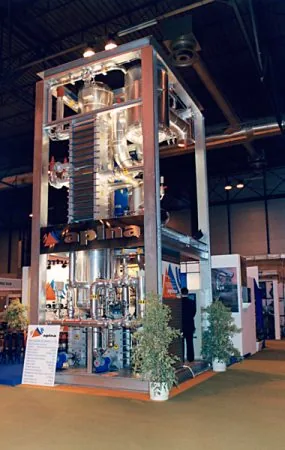
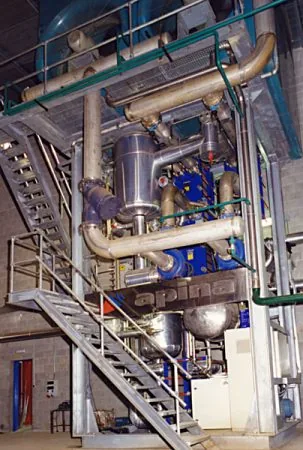
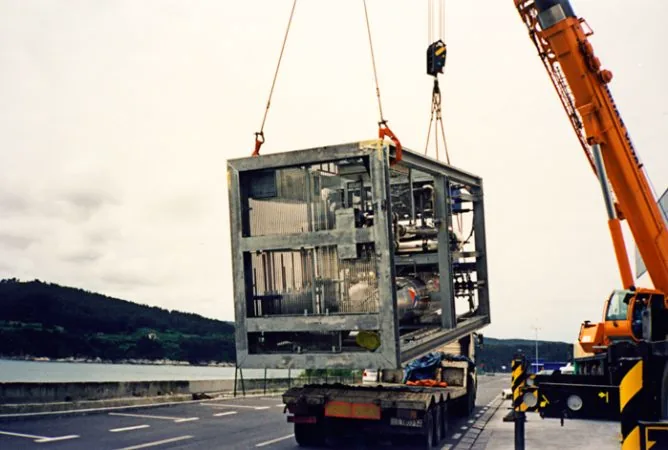
APINA has developed absorption modules of a unique, compact design, built entirely at our facilities and transported fully finished to their final site. It is a step forward in absorption systems: a machine with high cooling capacity —up to 2,500 kW of cooling power— that travels complete on a single truck. On site, work is kept to a minimum: connecting the module to the rest of the installation and charging the working fluids.
On top of the benefits of full workshop manufacturing comes the module's compactness, meaning a minimal ammonia charge and a very small footprint. With a continuous heat source it runs on minimal electricity —only that of the auxiliaries—: barely 5 % of what a compression installation of similar characteristics would consume.
Each module is built to the most demanding standards, with approvals from international bodies such as Lloyd's Register, Bureau Veritas or American Bureau. Its high-efficiency stainless-steel heat exchangers ensure a long life free of corrosion and oxidation. And as refrigerant it uses ammonia, recognised as the most eco-friendly, with no CFCs or HFCs.
Efficiency versus compression
In a real plant (Lecta Group, 1,700 kW of cooling with superheated water), the absorption module reaches a COP of 27.4 —cooling produced versus electricity consumed— against 3.3 for an equivalent compression system. Almost all the work is done by waste heat, not electricity.
In summary
Turnkey
Unique, compact design, built in the workshop and transported finished on a single truck to its site.
Minimal site work
Only connecting the module and charging the working fluids remain. Minimal ammonia charge and little space.
High power
Up to 2,500 kW of cooling power per module, with high cooling capacity.
Down to −60 °C
Negative evaporation temperatures for ice, freezer rooms and freezing tunnels.
Hot climates
Air condensation where evaporative systems are not viable.
Certified
Manufactured in accordance with Lloyd's Register, Bureau Veritas, American Bureau and other inspection bodies.
Absorption plants in operation
| Client | Country | Application | Power | Evap. temp. | Heat source |
|---|---|---|---|---|---|
| Gensabón Leyma | Spain | Milk pasteurisation | 800 kW | −1 °C | Hot water · 95 °C |
| Coren | Spain | Meat processing | 650 kW | −5 °C | Superheated water · 115 °C |
| Celeiro Port | Spain | HVAC & fish | 1,250 kW | −10 °C | Superheated water · 100 °C |
| Lecta Group · Motril | Spain | TESTIAC® | 1,700 kW | −15 °C | Superheated water · 110 °C |
| COVAP | Spain | Milk pasteurisation | 1,700 kW | −12 °C | Steam · 139 °C |
| C.A. Guissona | Spain | Meat dehydration | 2,000 kW | −4 °C | Hot water · 98 °C |
| Campofrío | Spain | Meat processing | 3,000 kW | −12 °C | Steam · 160 °C |
| Fripusa · Escuris | Spain | Ice plant | 250 kW | −12 °C | Steam · 139 °C |
APINA ammonia absorption modules in operation.
More in core technologies